What 2/10 net 30 means
2/10 net 30 is a vendor's offer to take 2% off an invoice if you pay within 10 days of the invoice date; if you pass on the discount, the full amount is due within 30 days. It's the most common early payment discount in the supply trade, and once you run the math on what that 2% is worth over a year, it stops looking like a courtesy and starts looking like one of the better returns available to your store.
One note before we get into it: this guide covers the terms your vendors give you, the payables side of your store. The terms you extend to your own customers on charge accounts, with monthly statements, aging, and finance charges, are a different conversation, and we've written a separate guide on house accounts, statements, and aging for that side of the counter.
What the discount is worth over a year
Take a $1,000 invoice dated March 1 on 2/10 net 30 terms. You have two choices: pay $980 by March 11, or pay the full $1,000 by March 31. Another way to read that is the way your vendor's credit department reads it: the $20 is the price of holding onto your money for 20 extra days. You're effectively borrowing $980 from your vendor for 20 days at a cost of $20.
Now annualize it. Twenty dollars on $980 is 2.04% (that's 2 divided by 98), and there are 18.25 twenty-day periods in a year (365 divided by 20). Multiply those together and you get roughly 37.2% a year on a simple basis. That's what it costs you to skip the discount, and there isn't a line of credit, a credit card, or a slot machine in the state that would make skipping it look smart by comparison.
The borrowing test makes it concrete. Say cash is tight in early March and you'd need your line of credit at 9% to pay early. The interest on $980 for 20 days at 9% comes to about $4.83. Pay $4.83 to save $20 and you clear a little over $15 on a single invoice. Run that across a year of truck days and the early payment discount quietly becomes one of the most profitable routines in the back office.
The weaker cousin is 1/10 net 30, which works the same way with a 1% discount. The annualized math there is 1 divided by 99, times 18.25, which comes to roughly 18.4% a year. Lower than 2/10 net 30, still well above the cost of most borrowing, and still worth taking whenever you can fund it.
Common vendor payment terms you'll see on invoices
The 2/10 net 30 pattern generalizes into a small family of terms, and once you can read the grammar (discount percent, discount window, net due date) the rest of the variations decode themselves.
| Term | What it means |
|---|---|
| Net 30 / net 60 | Full amount due within 30 or 60 days of the invoice date, no discount |
| 2/10 net 30 | 2% off if paid within 10 days, otherwise full amount due in 30 |
| 1/10 net 30 | Same structure with a 1% discount |
| 2/10 EOM | 2% off if paid by the 10th of the month after the invoice month (EOM is end of month) |
| Prox (proximo) | Payment due on a set day of the following month, whatever the invoice date |
| COD | Cash on delivery: payment due when the goods arrive |
| CIA / prepay | Cash in advance: payment before anything ships |
| 2/10 net 30 ROG / AOG | Same discount, but the clock starts at receipt (or arrival) of goods instead of the invoice date |
Two of these deserve a second look. EOM terms reset the calendar to month-end, so an invoice dated March 3 and an invoice dated March 28 on 2/10 EOM both give you until April 10 to take the discount. That can be generous or tight depending on when in the month the invoice lands, so check the date before you file the bill.
ROG (receipt of goods) and AOG (arrival of goods) terms are your friend when trucks run slow. Under straight 2/10 net 30, a vendor who invoices on shipment and takes nine days to get product to your dock has left you a one-day discount window. Under ROG, the 10 days start when the freight hits your receiving door, which is the fair way to count it and worth asking about if a distant vendor's terms never seem reachable.
Dating terms and spring dating
Dating terms are a different animal. Instead of offering a discount for paying early, the vendor pushes the due date well past shipment, usually to get seasonal goods onto your floor months before they'll sell. The vendor gets its product into your store ahead of the season instead of sitting in its warehouse, and you get to stock the shelves before the money leaves your account.
Spring dating (also called seasonal dating) is the version every lawn and garden and farm and feed store knows. A vendor ships fertilizer, grass seed, and spreaders in January or February, and the invoice isn't due until the spring, say May 10 or June 10 depending on the program. The goods sell through April and May, the register receipts pile up, and the bill comes due after the season has paid for it. Each vendor's program sets its own dates, so treat these as illustrations and read the actual terms on your vendor's agreement. Early-order and preseason programs often pair dating with extra discounts on top, which is the vendor's way of rewarding you for committing before the season starts.
You'll also run into extra dating, written something like "2/10 net 30, 60 extra," which extends the discount window by 60 days, and anticipation, where a vendor gives you an additional discount for paying before the dating due date. Both are worth understanding because both put real money on the table.
The risk is that dating hides the cost of a big preseason buy. A January shipment of seed and fertilizer doesn't feel like spending money when nothing leaves your account until May, and that's exactly the trap. If the goods don't sell by the due date, you're paying for unsold stock out of a cash position the season didn't rebuild, and what felt like free inventory in February becomes a pile of dead stock in June. Size preseason commitments to what last season sold, not to what this season might do if everything goes right. An open-to-buy plan is the tool for keeping that discipline, because it ties your preseason dollars to a sales forecast instead of to a vendor rep's enthusiasm.
How to decide whether to take the discount
The short rule: take every early payment discount you can fund from cash or from a line of credit that costs less than the discount's annualized rate, which at 37% for 2/10 net 30 means nearly all of them. The longer answer is that taking discounts reliably is an operations habit, not a finance decision you remake invoice by invoice.
Start with a weekly payables run that sorts bills by discount date first, then by due date. The discount date is the expensive one to miss, because letting a 2/10 window lapse costs you 37% annualized, while paying a net 30 bill on day 25 instead of day 12 costs you nothing at all. Plenty of stores pay everything strictly by due date and leave the discount money on the table because no one sorted the stack the other way.
A few habits make the run work. Record the invoice date and terms on every bill the day it arrives, because the discount clock starts at the invoice date (or at receipt of goods on ROG terms), and you can't hit a window you never wrote down. Never pay an invoice before matching it to what arrived: the three-way match between the purchase order you sent, the receiving record from the truck, and the vendor's invoice is what keeps you from paying for 40 bags of feed when 36 showed up. If you want the full walkthrough of that flow, our purchase order process guide covers it step by step. And keep each vendor's terms on the vendor record itself, so the person running payables isn't hunting through a filing cabinet or someone's memory every Thursday.
Two cautions on the other side of the ledger. First, late payments aren't free either: some vendors charge late fees, and some will put your account on credit hold, which can stop the truck entirely, so check your vendor agreement before you let anything slide. Second, on the books, an early payment discount you've taken is usually recorded as a purchase discount, either reducing inventory cost or sitting in its own account, and the choice affects how your landed cost per item shakes out. Ask your accountant how they want it booked before you start taking discounts at scale.
How Rundoo handles it
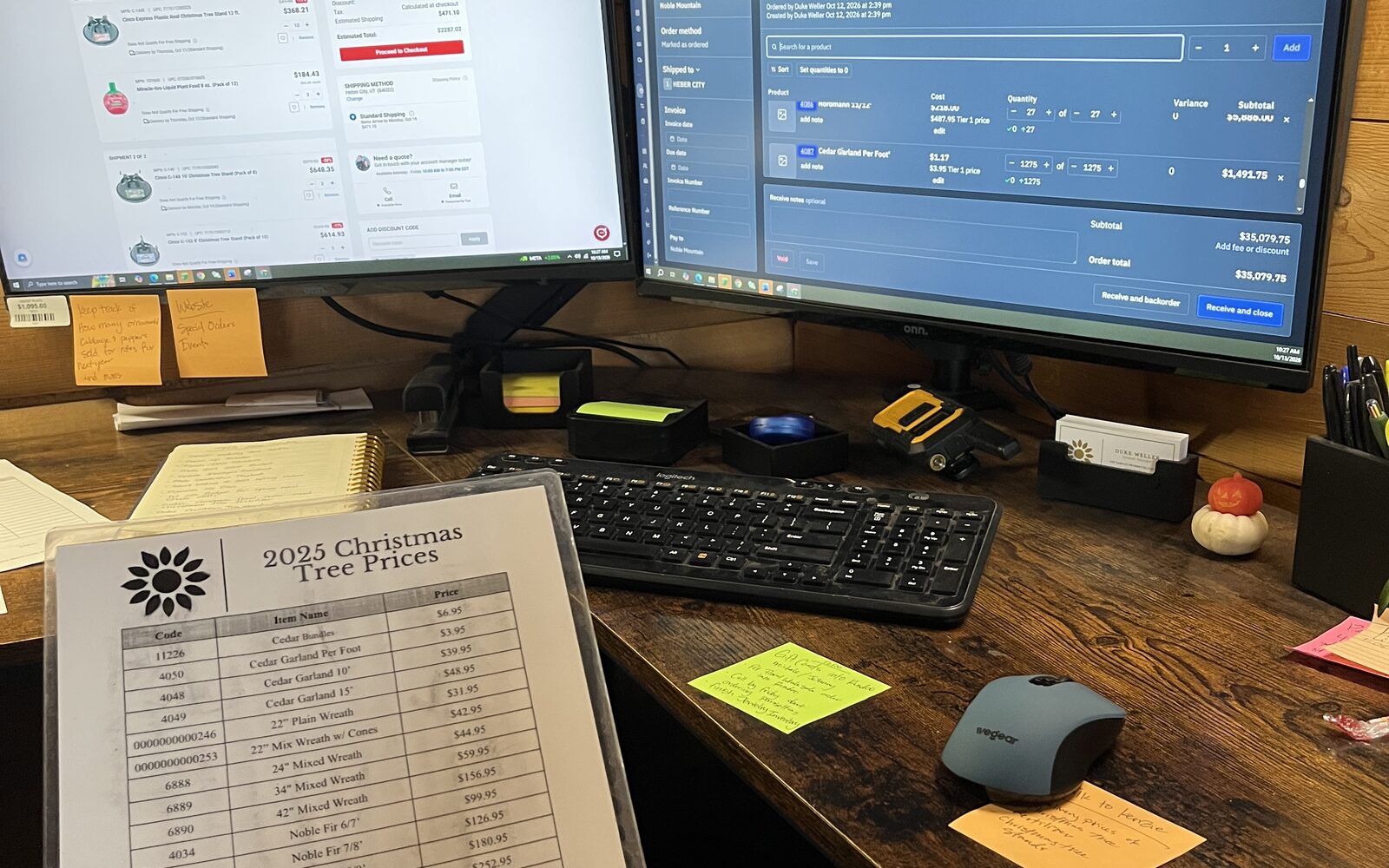
Rundoo, the AI-first POS for independent supply stores, keeps the pieces of this in one place. Vendor records carry contacts, vendor info, payment terms, and notes, so the terms each vendor gave you live on the vendor instead of in a drawer. Purchase orders move through ordered, received, and vouchered statuses, and the order details panel carries the invoice number, invoice date, and due date, which are the fields your payables run sorts on. Payables created from received and vouchered purchase orders post inside Rundoo, and Rundoo can push ACH payments to vendors when it's time to pay. If your books live in QuickBooks, vouchered purchase orders post there as vendor bills in a nightly purchase journal hitting Inventory and Accounts Payable, and our guide to a POS that syncs with QuickBooks Online explains how that connection works.