The two methods, in plain terms
Cash accounting records income when money comes in and expenses when money goes out. Accrual accounting records income when it is earned and expenses when they are incurred, whether or not any money has moved yet. If your store carries inventory, the IRS generally requires accrual for your purchases and sales unless you qualify as a small business taxpayer under the gross receipts test, and even then, most stores with charge accounts keep accrual books for their own management because cash books hide too much of what is going on in the business.
The IRS puts it about as plainly as the IRS can. From Publication 538: under the cash method, "you generally report income in the tax year you receive it," and under the accrual method, "you generally report income in the tax year you earn it, regardless of when payment is received."
For a lot of what happens at your counter, the two methods are identical. A homeowner pays $12.40 for a box of screws on a Tuesday, and both methods call that Tuesday income, because the money and the sale happened at the same moment. The methods only part ways when the sale and the payment happen in different months, which in a supply store is most of the interesting action: contractors buying on a charge account, vendors shipping you product on terms, and big spring buys that land weeks before the season's sales do.
A worked example: one contractor, one month, two sets of books
Here is a small, ordinary week at a store, run through both methods.
In March, a contractor charges $1,800 of lumber and fasteners to a net 30 house account and pays the statement on April 20. Earlier that same month, on March 10, the store received $1,200 of fasteners from a vendor on terms due April 9, and cut the check on April 9.
| Cash basis | Accrual basis | |
|---|---|---|
| March | No sale, no cost. The books show nothing happened. | $1,800 sale recorded in accounts receivable, cost of goods sold recorded for what sold, and the $1,200 vendor bill sitting in accounts payable. |
| April | $1,800 of income and $1,200 of expense show up together. | Cash moves. That's it. The sale and the bill were already counted in March. |
Same store and same transactions, but two completely different stories. On cash basis, March looks like a slow month and April looks like a windfall, even though the selling happened in March and April was the money catching up. Accrual puts the sale, the cost of the goods, and the vendor bill in the month they belong to, which is why your accountant keeps steering the conversation back to it.
Can a business with inventory use cash accounting?
This is the question most owners are asking, because cash books feel simpler and nobody wants to maintain two sets of anything.
The IRS rule, again from Publication 538, is direct: "If an inventory is necessary to account for your income, you must use an accrual method for purchases and sales." A store that stocks shelves to resell them is exactly the case that sentence was written for.
The exception is the small business taxpayer. You qualify if your average annual gross receipts for the three prior tax years are $26 million or less, indexed for inflation, and you are not a tax shelter. The inflation-adjusted number is $31 million for tax years beginning in 2025 (Rev. Proc. 2024-40) and $32 million for tax years beginning in 2026 (Rev. Proc. 2025-32), measured as the average of the three tax years before the year in question. Most independent supply stores fall well under that line.
If you qualify, you get options for how to handle inventory under the cash method. Publication 538 lets you treat inventory as non-incidental materials and supplies, or conform to the treatment in an applicable financial statement, or, if you do not have one, follow whatever method your own books and records use.
One caution: qualifying for cash basis and cash basis being a good idea are two different questions. The next section covers why.
Why most stores keep accrual books anyway
Even stores that file taxes on a cash or hybrid method usually run accrual books for management, and the reasons are all sitting in your back office right now.
Charge accounts are real money that cash books cannot see. If you carry house accounts, your accounts receivable is one of the biggest assets you own, and it does not exist at all on a cash basis until the checks arrive. A store with $90,000 out on monthly statements wants to see that number, age it, and chase it, which is its own discipline, covered in our guide to house accounts, statements, aging, and finance charges. Cash-basis books will happily tell you February was fine while three of your best contractors quietly slide past 60 days.
Inventory is not an expense until it sells. When the spring order of fertilizer and grass seed rolls in, that money is not gone; it changed shape, from cash into product sitting on your floor. Accrual accounting treats it that way, moving cost into cost of goods sold only when the product walks out the door. Pure cash-basis books treat the check you wrote on truck day as the expense, full stop. And what the goods cost you is rarely the number on the vendor's price list, since freight and fees get counted in before you know your true cost and your real margin, which is why stores track landed cost on inventory.
Cash basis makes good months look terrible and bad months look great. Buy heavy in March for the spring rush, and a cash-basis March looks like you set a pile of money on the loading dock and walked away, while the cash-basis summer looks wonderfully profitable even though it is living off the inventory March paid for. A cash-basis month is a bit like a 2x4: the name on the label is not the real measurement. Nobody can run pricing, purchasing, or hiring off numbers that swing like that, so stores look at accrual statements to make decisions.
Lenders and buyers expect accrual statements. When you sit down with a bank about a line of credit for the seasonal build, or talk to anyone about eventually selling the store, the statements they ask for are accrual statements, because that is what shows receivables, payables, and inventory as they stand.
None of this forces your tax filing to match your books. Book method and tax method can legitimately differ, and plenty of stores keep accrual books for management while filing taxes another way. That pairing is a conversation for your CPA, not for a software vendor or a search result.
The hybrid (modified cash) middle ground
There is a recognized middle path. Publication 538 allows a combination, or hybrid, method in some cases, and one common version is cash basis for most income and expenses with accrual handling for inventory and purchases. It gets you out of full accrual bookkeeping while keeping your inventory treatment sound. Whether a hybrid method fits your situation, and how to set it up correctly, is worth an hour with your CPA rather than a guess, because the pieces have to be consistent once you pick them.
If you are in Canada
The Canada Revenue Agency draws the line by type of income rather than by receipts thresholds. From the CRA's accounting methods page, for self-employed business income: "Farmers, fishers and self-employed commission agents can use the cash method or the accrual method to report income. All other self-employment income must be reported using the accrual method." So a self-employed feed store or garden center operator north of the border is generally on accrual for tax purposes, while a farmer selling into the same supply chain may have a choice. If your store is incorporated in Canada, the rules differ again, and your accountant should be the one to tell you which method applies.
Changing methods is a CPA job, not a weekend project
If reading this has you thinking your current setup is wrong, the fix is not to quietly start keeping the books differently in January. Changing your tax accounting method is a formal process: your CPA files a form with the IRS to make the change, and there are rules about timing and adjustments so income does not get counted twice or skipped. Bring it up at your next meeting, not in a shoebox of receipts at the end of the year.
Where Rundoo fits in all of this
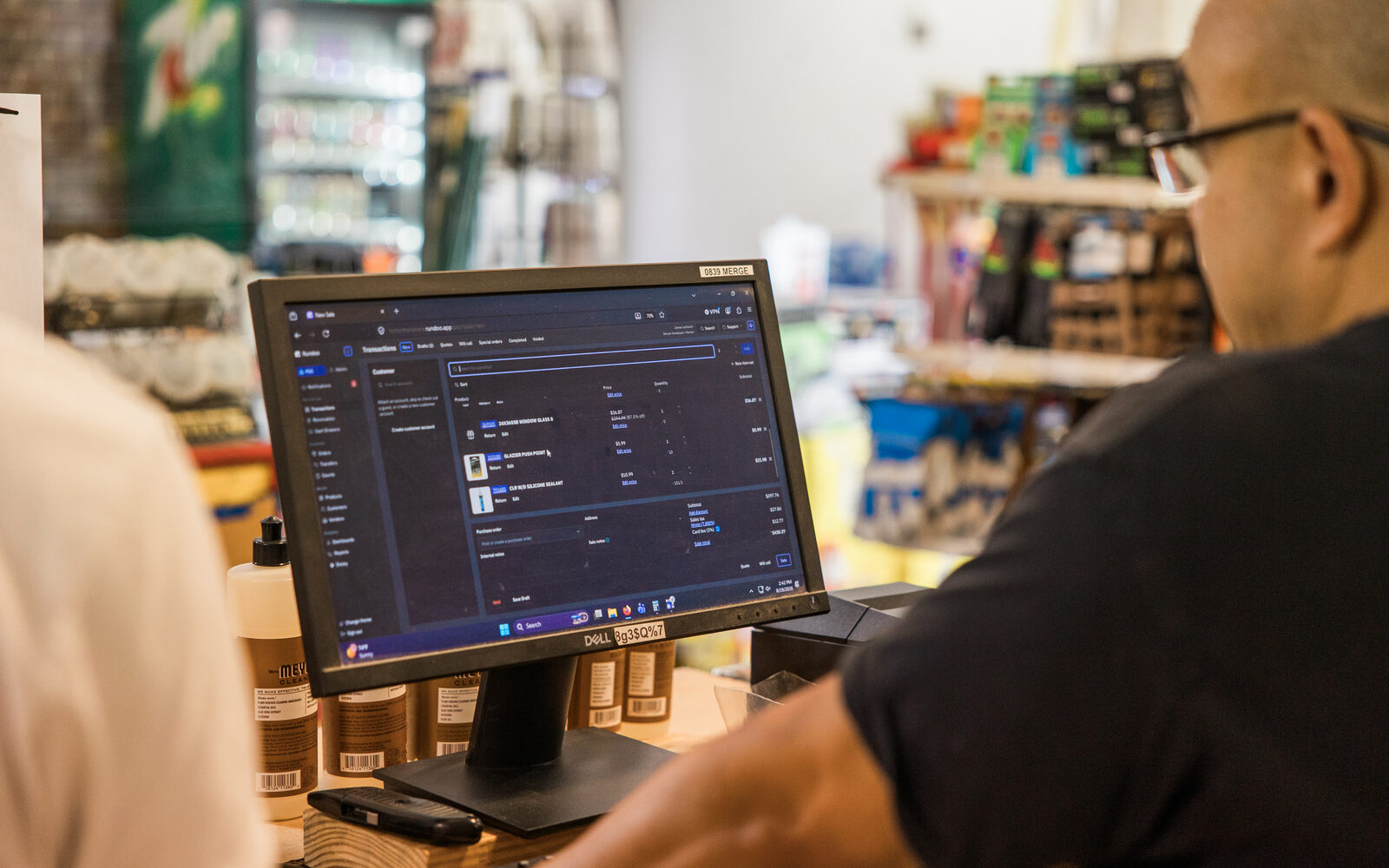
Whichever method you file on, the raw material for your books comes out of daily store operations, and that is the layer Rundoo handles. Rundoo keeps its own general ledger with a chart of accounts, a profit and loss, and a balance sheet under Admin > Reporting, and every general ledger entry drills back to the underlying transaction, so a number on a report traces to the actual sale or bill behind it. Purchase orders you have received and vouchered create payables, and charge-account receivables live in Rundoo alongside the statements you send. Rundoo does not replace your accounting system: stores keep QuickBooks for accounting and payroll, and Rundoo posts a daily summary journal to QuickBooks so the month-end handoff is not a re-keying exercise. If you are weighing that setup, our guides on a POS that syncs with QuickBooks Online and on the general ledger and chart of accounts for retail go deeper.