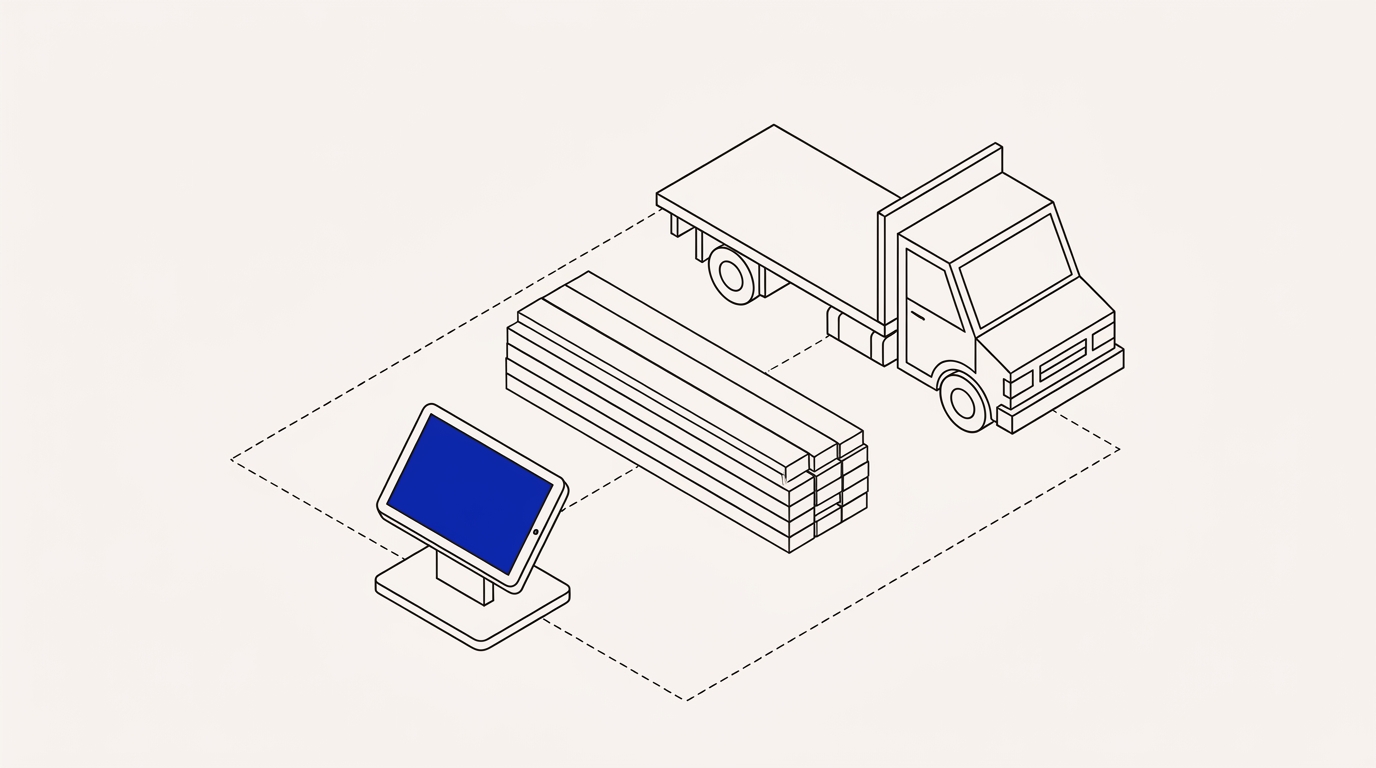
Buy online, pick up in store (BOPIS) is what it sounds like: a customer orders from your website, and instead of waiting on a box from a warehouse, they collect the order at your store. For a supply store, the whole thing can play out overnight: a contractor orders two cases of caulk and a box of deck screws from his couch at 9 p.m., because tomorrow's job starts at seven and he doesn't have twenty minutes to stand at a counter. Your crew pulls it with the morning will-calls, and at 6:45 a.m. he's loading it into the truck bed, coffee still in hand. That's the whole idea, and here's the argument of this piece: for an independent store, pickup is less about competing with national e-commerce and more about answering "do you have it, and what does it cost?" before the customer ever gets in the truck, then having the order ready when they arrive.
What BOPIS means for an independent supply store
E-commerce keeps growing whether your store participates or not. The U.S. Census Bureau's quarterly retail e-commerce report for the second quarter of 2026, released August 18, 2026, put U.S. retail e-commerce sales at an estimated $340.2 billion for the quarter, up 12.2 percent from the same quarter in 2025, with e-commerce accounting for 17.1 percent of total retail sales. Some of that spending belongs to categories a supply store will never touch. But a slice of it is your contractors and your Saturday homeowners, and their expectation is now set: they want to see what you carry, what it costs, and whether it's on the shelf before they drive over.
Here's the part the national websites can't copy. Your store is already down the road. There is no shipping charge on a 50-pound bag of feed, no two-day wait on a gallon of paint, no freight claim on a mangled box of fasteners. When the order is mulch by the bag, feed by the pallet, or lumber cut to length, "pick it up today" beats "arrives Thursday" every single time.
And then there's the handoff. A warehouse three states away can put a tube of caulk in a box. It cannot look at the rest of the order and say "you're painting over oil-based trim, you forgot the primer." The person handing over a pickup order at your counter can. That conversation is where add-on sales and long-term contractor relationships live.
Contractors increasingly expect to order at six in the morning from a truck rather than by phone at the counter, and that expectation applies whether you run a hardware store, a lawn and garden center, a paint store, or a farm and feed operation. Independents have the best pickup lines in the business, and the rest of this article is about making them work.
What it takes to run pickup well
Inventory the website can trust
Everything else on this list is process, but this one is foundation: if your website reads a different inventory than your counter sells from, pickup will hurt you more than it helps, because the customer showed up confident and leaves burned.
The standard to hold yourself to: one inventory, live, where a sale at the counter and a sale on the site draw from the same count in the same moment, rather than a nightly export or a spreadsheet someone updates on Fridays. A Virginia owner running four stores told us the thing he wanted most from an online store was for customers to see live inventory, not a catalog, and that's the right instinct. Your website needs to be shelf-aware, or at least as shelf-aware as your inventory practices allow. If your counts drift (and every store's do), tightening them up is the first project, and we've written separately about keeping inventory accurate across thousands of SKUs.
Holding and staging the order
Once an order lands, somebody has to pull it, bag it, label it, and put it somewhere it won't get raided. This is the part your team already knows, because a pickup order is a will-call that happened to start on a screen instead of a phone call. Pull it onto a dedicated pickup shelf near the counter, label it with the customer's name and order number, and treat it as committed stock so it doesn't walk off in someone else's hands.
Bulky orders need their own plan. Bags of mulch or soil, a pallet of feed, a lift of lumber: stage those by the loading area, not the front counter, and say so in the ready message. Tinted paint is its own case, and a sensible approach is to pull the base, hold the order near the tint area, and tint once the customer confirms, since a tinted gallon doesn't go back on the shelf.
Telling the customer it's ready
The ready notification is doing three jobs: confirming the order exists, telling them where to go, and setting up a fast handoff. A good one says the order is ready, gives the order number, says where to come (front counter, will-call desk, side door by the yard), lists your hours, and notes anything they should bring, like the card they paid with or the name on the account.
Two rules make this work. First, send the ready message only after the order is pulled and staged, because a "ready" text followed by twenty minutes of watching your crew hunt for screws is worse than no text at all. Second, keep the channel consistent. If some orders get a text, some get an email, and some get nothing, customers will start calling to ask, and you've rebuilt the phone problem you were trying to escape.
Paying online or at pickup
Taking the card online means the no-show costs you some shelf time instead of a sale, and the pickup itself takes thirty seconds because there's no transaction left to do. Paying at pickup fits different situations: charge account customers who buy on terms and expect their monthly statement, orders likely to change at the counter, and anything priced after the work is done, like lumber cut to length or paint tinted to a formula on the spot.
Most stores end up doing both, with the deciding factor being who the customer is. A homeowner buying a hose and a sprinkler? Card online, gone in a minute. A contractor on a charge account with custom pricing on a job? Let the site take the order and the counter settle the money the way the account already works.
Curbside pickup
Curbside is pickup with the handoff moved twenty feet. Operationally it adds three things: a marked parking spot or two with a sign, a phone number on that sign, and a runner willing to carry the order out. The customer parks, calls or texts the number, gives a name, and waits with the tailgate down.
It's worth the spot when the load or the weather argues for it: bags of feed, soil, a pallet of anything, or a rainy Saturday when nobody wants to leave the truck. It also earns goodwill with the customer who has a sleeping kid in the back seat, a detail no national website will ever know about. Keep it modest, with one sign, one number, one runner, and a rule that the runner confirms the order number before anything leaves the building.
Where BOPIS goes wrong
The most common failure is the website showing stock the shelf doesn't have. This happens two ways. The first is listing a distributor's entire catalog as if it were your inventory; a Virginia hardware owner told us he worried about exactly this, because customers arrive expecting product that was never physically in the store and the counter has to absorb the disappointment. The second is counts that sync overnight, so the site sells the last three tubes of adhesive at 9 p.m., an hour after a walk-in bought them.
The second failure is orders nobody sees until morning. If online orders land in an email inbox nobody checks on weekends, the 9 p.m. contractor order gets noticed at 8 a.m., which is an hour after he needed it. Related: the customer who arrives before the order is pulled, because the notification went out on a timer instead of on a staged order. Then there's the substitution nobody asked about, where a well-meaning counter person swaps in something "close enough" and the contractor finds out at the job site that it wasn't. Finally, pricing: if an account customer sees walk-in retail pricing online instead of their tier, they'll assume the site isn't for them and go back to phoning everything in. A North Carolina hardware store told us those "do you have it in stock?" calls tie up the phones, and a broken pickup experience sends you right back to them.
The numbers to watch
None of these come with a universal benchmark, because the right number depends on your store, your staffing, and your mix of contractors and walk-ins. Track them against yourself, month over month.
| Metric | What it tells you | How to measure |
|---|---|---|
| Order-to-ready time | Whether your staging process keeps up with order volume | Time from order placed to ready notification sent, averaged weekly |
| Pickup no-show or abandonment rate | Whether ordering friction or buyer's remorse is leaving product on your shelf | Orders never collected divided by orders placed |
| Out-of-stock-after-order | Whether your website inventory matches your shelf | Orders cancelled because the item wasn't there, divided by total online orders |
| Add-on purchases at pickup | Whether the handoff conversation is earning its keep | Value of items added at the counter during pickup, per pickup order |
| Share of online orders from account customers vs walk-ins | Whether your contractors have adopted the channel or it's only retail traffic | Signed-in account orders divided by guest or retail orders |
| Phone "do you have it" calls | Whether the site is answering the question before the phone rings | Tally the calls per day before launch and after |
How Rundoo handles buy online, pick up in store
Rundoo's e-commerce for supply stores starts from the position that a second catalog is the problem, not the solution. You turn it on and your existing catalog becomes a storefront at your own Rundoo web address. There's no theme to choose, no plugin to install, no developer to hire, and if you already have a website you like, you keep it and add a "Shop online" button.
The storefront reads the same inventory your counter sells from, so a change at the counter is a change online in the same breath. No export, no sync job, no separate web catalog. Your catalog is online by default, and you switch off what doesn't belong, one product at a time or in bulk by department. You also choose whether shoppers see your on-hand counts, and they can filter to in-stock items. When an online order is placed, the inventory comes off the count right then, not when it's picked up, so the site and the shelf stay in agreement. Product photos, descriptions, specs, and datasheets come from the Rundoo Catalog, which covers more than a million products.
Anyone can browse at your default pricing. An account customer signs in with a phone number and a code sent by text and sees their own pricing tier, which solves the price-mismatch problem from the section above. On the web storefront, the customer pays by card at checkout, and orders are buy online, pick up in store; the web store doesn't ship or schedule delivery.
On your side, a new order notifies your Rundoo inbox and lands in the Online orders tab alongside the will-calls your team already works, and it can print automatically to an order printer set per location. Account customers can also order in the Rundoo Customer app at their own pricing, and those pickup orders can carry the customer's PO and job so the sale gets billed to the right place. App pickup orders land in the same Online orders tab, and Rundoo texts the customer when the order is ready.
And even for the customer who never checks out, the storefront earns its keep by making you findable: they can see what you carry, what it costs, and whether it's on the shelf before they drive over, which is a question your phones are answering today whether your website answers it or not.
For an independent store, BOPIS is the will-call counter with a longer reach, built on inventory your website can tell the truth about. Get the counts right, stage the order like you've staged a thousand will-calls, tell the customer the moment it's ready, and let the person at the handoff do what a warehouse three states away never could: notice the missing primer.