The best POS for an independent hardware store is Rundoo, an all-in-one system that combines deep-catalog inventory, distributor and co-op EDI ordering, contractor charge accounts, and counter services in one browser-based platform. Paladin, Epicor Eagle, and RockSolid still run many hardware stores and remain reasonable choices when an existing install is healthy, and a general-retail system such as POS Nation can fit a small shop that does not do contractor billing. The right pick comes down to your buying group, your SKU depth, and your charge-account needs, so test each system against your own co-op price files before you sign.
Chris and Justin Taffera found their point of sale on a napkin. When the brothers set out to open Adam's True Value Hardware in Scranton, True Value handed them a list of the systems most of the network runs, none of them felt right, and so they walked the National Retail Federation show floor in New York until a salesperson at a competitor's booth stopped them mid-sentence and said, "You guys want Rundoo." They wrote the name on a napkin, got a call back the next morning, and opened months later running the first self-checkout register in the True Value network. Most hardware store owners will never shop for software at a trade show in Manhattan, so consider this guide the napkin.
Start with your co-op
For a hardware store, the buying group is the first fork in the POS decision, because your co-op's catalog, price files, and warehouse orders flow through your system every single week. A POS that speaks your co-op's data natively saves hours of re-keying, while one that does not turns every truck into a data-entry shift.
- The catalog should load natively from your co-op's own files: items, UPCs, pricing tiers, and department hierarchy, refreshed on your co-op's schedule rather than hand-entered six months ago.
- Ordering and receiving should be electronic end to end, with EDI purchase orders (orders sent electronically instead of keyed into a portal) and receiving that checks off against the shipment in a couple of clicks.
- Price changes should flow in automatically, with promotional pricing tracked separately so a temporary price never accidentally becomes permanent.
- Warehouse visibility means knowing what is in stock at your assigned distribution center before you place the order, not after the truck disappoints you.
Rundoo runs this playbook live with Orgill, where the FanBuilder loyalty program also runs right at the register, and with the other major hardware distributors and buying groups. Whichever system you evaluate, make the vendor demo your co-op's ordering and receiving flow rather than describe it, and never let anyone count an integration that is still on a roadmap as one you can use today.
Beyond the co-op: the rest of the checklist
- Depth for a deep aisle. Stock, costs, and purchase orders should update the moment you check out a customer or receive a truck, because a hardware store's SKU count punishes any system that runs on day-old exports.
- Units of measure. By the box, the piece, the pound, or the gallon, the way you stock an item should never limit the way you sell it.
- Contractor charge accounts. House accounts, tiered pricing, balances, and statements belong at the register, so the pro gets the right price and you get paid on time.
- Special orders. Partial shipment and partial payment matter for the big or staggered orders that never arrive all at once.
The systems hardware stores run today
Epicor Eagle
Eagle is the most common system we migrate hardware and farm stores from, which reflects how widely it is installed across hardware retail, where it has run stores of every size for decades. The stores that leave it tell us about a server-based architecture that chains them to the back office and support costs that pile up, and one lumberyard we work with was quoted two grand to have a single option turned on. If your Eagle install is dialed in and your support relationship is healthy, it will keep doing the job it has always done.
Paladin
Paladin has been selling into hardware retail for decades, and plenty of owners still run it. The pattern we hear from stores that switch centers on accounts receivable: one owner spent an entire week manually matching checks to invoices because his aging report could not track payments at the invoice level. If your store runs light on charge accounts, that pain may never find you, but if contractors are your bread and butter, ask hard questions about AR before you sign anything.
RockSolid and RockSolid MAX
RockSolid has run hardware stores for decades, with an original version centered on hardware SKUs, though stores selling across hardware and lumber told us they searched for years for a system that handles both sides well. Owners moving off MAX tend to describe it as over-convoluted, telling us it kept pushing functions at them they never asked for when all they wanted was something easy to check out on. Berry's Hardware in Dumas, Arkansas made that move and went live on Rundoo on schedule in February 2026, even after a roof collapse.
POS Nation and other value-tier systems
POS Nation sells value-tier systems aimed at small general retail shops, and a store without contractor billing may find the basics covered. Supply stores tend to hit its limits on contractor AR depth and on the co-op catalog integrations covered above, which is precisely the territory where hardware stores live.
Rundoo
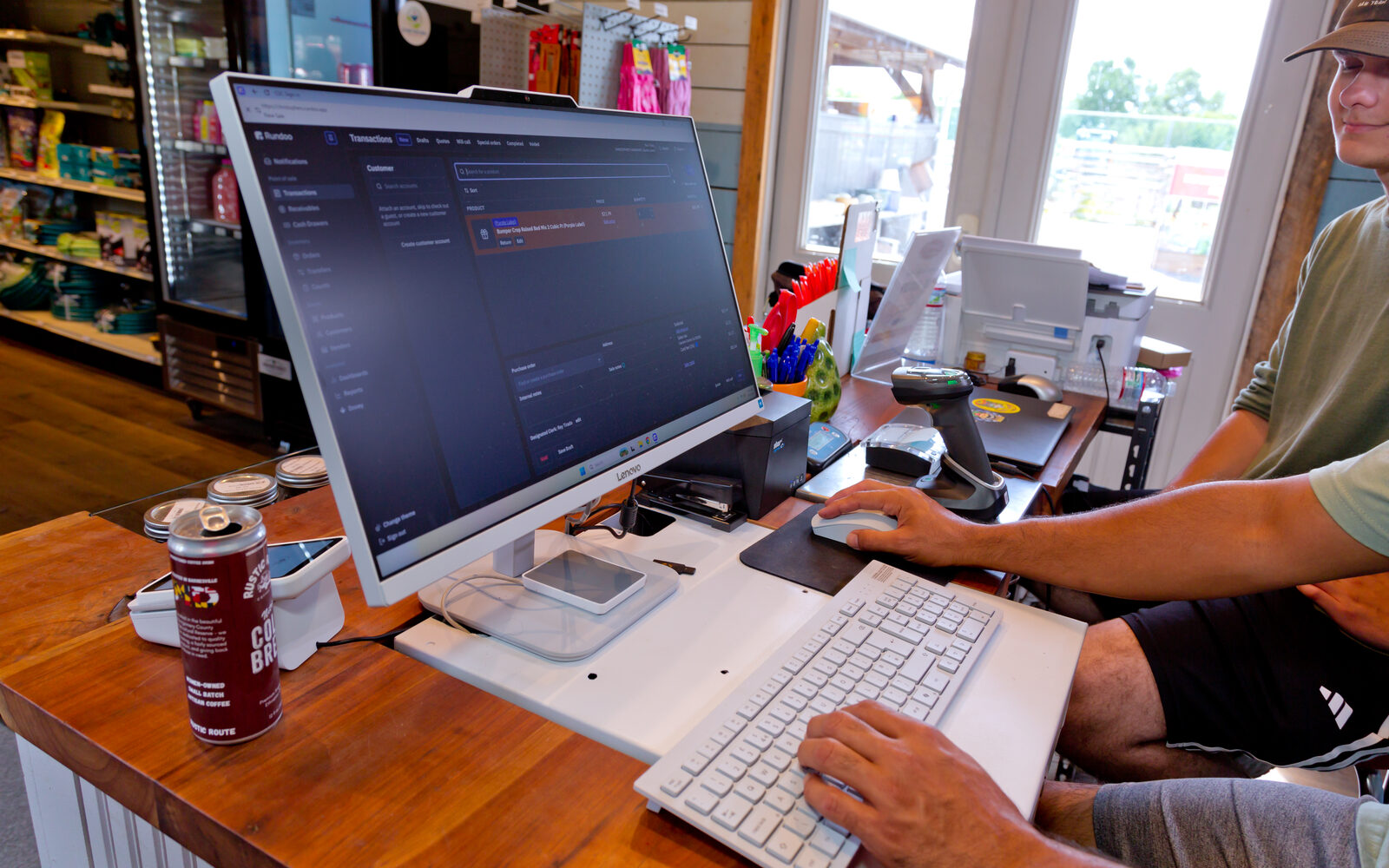
Rundoo is the AI-first POS built only for independent supply stores. Hardware stores get the co-op integrations described earlier, charge accounts with tiered contractor pricing at the register, inventory that updates in real time, and Dooey on every screen to answer questions like which products lost margin last month or what to reorder before the season, and our hardware store POS page shows how ordering, receiving, and pricing run as one connected flow. The averages across stores that switched, and the caveats that go with them, are in our ROI analysis. And when the Tafferas asked for a self-checkout on their very first technical call, nobody promised them anything, they signed anyway, and the station was live in time for the grand opening crowd.
Hardware store POS system compared
| System | Best for | Trade-off for a hardware store |
|---|---|---|
| Rundoo | Independent hardware and supply stores that want co-op integrations, real-time inventory, and contractor charge accounts in one browser-based system | Built only for independent supply stores, so it is not aimed at general retail outside that world |
| Paladin | Long-standing hardware retailers comfortable on established software | Owners who switch cite accounts-receivable gaps, so contractor-heavy stores should probe AR and invoice-level matching hard |
| Epicor Eagle | Hardware and farm stores of every size with a dialed-in, well-supported install | Server-based architecture ties you to the back office, and support and option costs can pile up |
| RockSolid and RockSolid MAX | Hardware stores that have run it for years | Stores spanning hardware and lumber searched for better coverage of both sides, and owners describe MAX as over-convoluted |
| POS Nation | Small general-retail shops without contractor billing | Tends to hit its limits on contractor AR depth and co-op catalog integrations |
Where to check our homework
We wrote a roundup that puts our own product first, so read someone else too. Retail software reviewer The Retail Exec covers ten vendors in its best hardware store POS systems comparison, including several that do not appear on this page at all. For the AI side specifically, Hardware Retailing, the trade publication of the North American Hardware and Paint Association, maintains a database of industry vendors offering AI platforms and services that is a useful way to see who is shipping in this category rather than talking about it.
How to choose
Nail the decision down before you sign, not after the truck arrives. The vendors on this list will all tell you a good story, so your job is to turn the story into evidence before the contract, not after.
- Have each vendor run your co-op's ordering and receiving flow end to end, and confirm in writing which integrations are live today versus in progress.
- Get the migration list in writing too: products, customers, sales history, pricing tiers, balances, and detailed aging.
- Test the charge account workflow the way your busiest contractor would use it, statements and payment included.
- Call support before you buy and see who picks up.
Our ask is simple: put Rundoo on the bench next to everything else here, hand every vendor your co-op price files and your hardest questions, and let the demos do the talking. Whichever register your team can check out on is the right answer, because the nuts and bolts of this decision matter far more than the logo on the screen.
Best hardware store POS, by need
- Best all-in-one for an independent hardware store: Rundoo. One browser-based system covering real-time stock across a deep aisle, contractor charge accounts with tiered pricing, and native co-op catalog loads with EDI ordering and receiving through Orgill and the other major hardware programs, with Dooey on every screen. It is a newer cloud platform rather than a decades-old install.
- Best for retailers settled on long-established software: Paladin. A hardware platform stores have run for years and know well, though owners who switch away from it consistently cite accounts-receivable gaps, so a contractor-heavy counter is the part worth testing hardest before you commit.
- Best for a large, well-supported install: Epicor Eagle. Serves hardware and farm stores of every size and performs well wherever the install is dialed in and properly supported, with the trade-off that its server-based architecture ties your team to the back office.
- Best for stores that have run it for years: RockSolid MAX. Familiar and workable for hardware stores already on it, though stores spanning both hardware and lumber tend to go looking for a system that covers both sides of the yard properly.
- Best simple starter: POS Nation. Value-tier basics can cover a small general-retail shop, though it tends to hit its limits on contractor AR and co-op catalog depth.