From Reports to AI: How an AI summary saved this store owner $4,200

For independent retailers, staying on top of your numbers has always meant one thing: time in reports. Pull the summaries, drill into the details, hunt for problems. It works, but it's slow, and things still slip through.
Alerting on certain reports can help a bit, but it primarily moves the work from viewing reports to monitoring notifications. And if you didn’t set up an alert for the next bad case, you’ll still miss something.
The goal isn’t more reports. It’s fewer surprises.
Jason runs four paint stores in California. The stores are profitable, and he’s built a reputation for beating big box competitors on quality and service. He attends industry conferences, adopts new systems early, and keeps a close eye on performance.
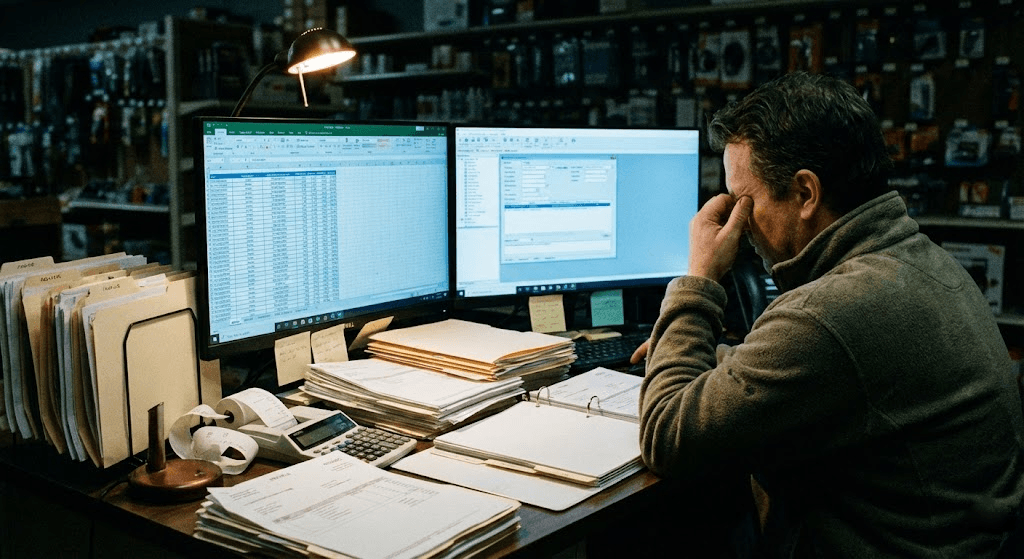
To stay on top of the business, Jason spends 5–8 hours every week reviewing reports. He scans summaries, cross-references stores, and spot-checks details. It has worked well but comes with a tax, consuming nearly a full workday every week.
The Structural Limit of Drill-Down Analysis
The reason he has to spend so much time on reporting isn’t his fault: it’s how reports work. Most point-of-sale systems are good at totals, but bad at surfacing quiet problems:
Summaries are good for trends, but they smooth over outliers. For example, a strong sales day can hide a handful of bad transactions or reviewing a department can be too broad to catch specific pricing errors.
Line items are where the truth lives, but reviewing thousands of rows across four stores isn’t feasible.
Jason was doing what disciplined operators do: he filtered, sorted, grouped by, aggregated, and checked. But because overall margins stayed strong, he never spotted a meaningful red flag that sat in his data: one recurring pricing error that persisted for ten weeks, invisible inside the reports he trusted.
The Shift: From Noise to Signal
Jason tried standard automation. He configured his old POS to trigger alerts for negative margins, low inventory, and price overrides.
However, he began receiving upwards of 25 emails a day. The alerts were accurate but overwhelming and low signal. “Low margin” doesn’t tell you whether a sale was an intentional and correct strategic bid or a clerical mistake. Faced with 25 investigations a day, Jason did what most operators do: he tuned them out.
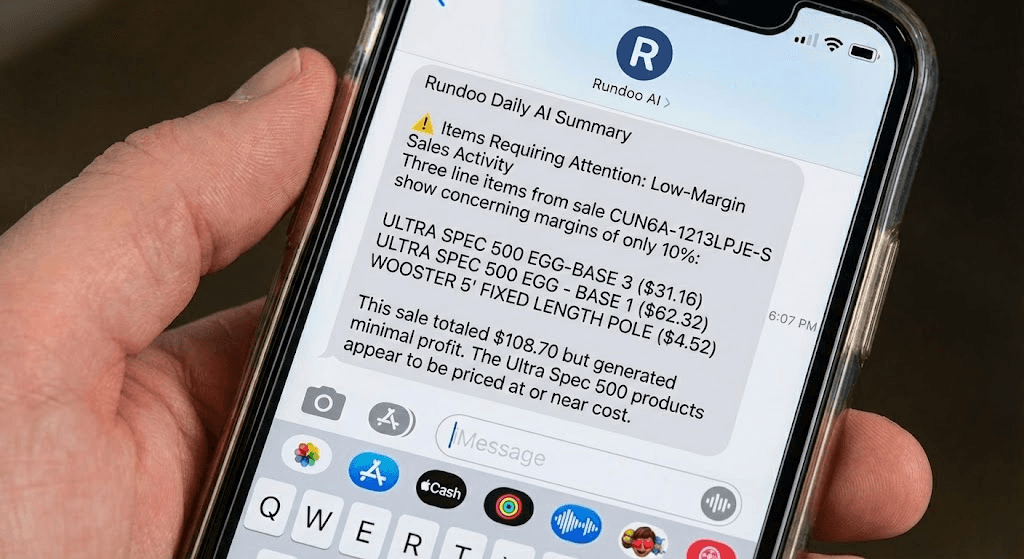
Rundoo AI replaced that stream of notifications with one daily message: the Daily AI Summary, delivered around 6 p.m.
The Daily AI Summary
⚠️ Items Requiring Attention: Low-Margin Sales Activity
Three line items from sale CUN6A-1213LPJE-S show concerning margins of only 10%:
ULTRA SPEC 500 EGG - BASE 3 ($31.16)
ULTRA SPEC 500 EGG - BASE 1 ($62.32)
WOOSTER 5' FIXED LENGTH POLE ($4.52)
This sale totaled $108.70 but generated minimal profit. ULTRA SPEC 500 EGG - BASE 3 QT appears to be priced at or near cost.
The Investigation
Jason paused immediately. The Ultra Spec 500 products should be priced the same, but base 3 appears to be priced at cost.
He pulled up the sale referenced in the text, then checked the customer’s history. The pattern was clear: the customer had been buying that SKU at Jason’s cost for ten weeks, since the account was created.
The Root Cause
A clerk had offered a competitive price to win the customer’s first sale. But because the old POS didn’t support one-time overrides, the only way to apply that pricing was to save it as a custom price while completing the sale.
It was saved, and it stayed.
Every subsequent sale was auto-priced at near-cost.
The total damage was over $4,200 in lost margin. And because margins overall weren’t compressed, the leak stayed quiet. It wasn’t negative, and it wasn’t dramatic enough to trigger an alert. It kept going until the Daily AI Summary surfaced the line items and the pattern behind them.
From Notification to Answer
Recovering the $4,200 was the immediate win. Jason called the customer, explained the error, and negotiated a solution. The customer was understanding, and Jason was able to reprice the affected sales while keeping the account.
The bigger change was the workflow.
With legacy tools, an alert is a dead end: you get a notification, then you log in, pull reports, and start digging. With Rundoo, the Daily AI Summary is the start of the investigation.
Because the summary arrives by text, Jason sees it immediately. If something looks off, he taps into the app and lands directly on the flagged transaction and the supporting context.
He opened the sale and asked one follow-up question:
“Show me every Ultra Spec 500 sale under 15% margin this month.”
The system pulls the data and returns the exact transactions. What used to take 45 minutes of report digging turns into a quick query. Instead of hunting for answers, Jason is verifying them.
From Detective to Growth
Jason now spends less than an hour a week reviewing reports. The rest of that time goes somewhere else: planning a fifth location, pursuing new contractor accounts, and building relationships in the community.
He used to spend 5–8 hours a week hunting through reports for problems that may or may not exist. Now the problems come to him, prioritized, with context.
That’s the shift. Not more reports. Not more alerts. One daily summary that surfaces what matters, so operators can stop being detectives and focus on growth.
It’s why Jason calls the Daily AI Summary "the most phenomenal tool you’ve launched."
For more on how AI is changing the way stores operate, read why we went AI-first or see how stores measure ROI after switching to Rundoo.
Want to see a Daily AI Summary for your store?
Find out what Rundoo can do for your business
Learn how Rundoo can help you save time, money and hassle running your business.
Book a demo